How IIoT Differs from Traditional Industrial Automation and Core Components of an Industrial IoT System
Part 1: Industrial Internet of Things (IIoT) Guide: Complete 2026 Handbook
The Ultimate Guide to Industrial IoT, Smart Manufacturing, and Connected Industrial Systems
Manufacturing has undergone remarkable transformations over the past century. Factories evolved from manual production lines to electrically powered machinery, then to programmable automation, and now to intelligent, interconnected operations powered by data. At the center of this transformation is the Industrial Internet of Things (IIoT)—a technology that is reshaping how industries monitor equipment, optimize production, reduce downtime, and make informed business decisions.
Unlike traditional automation, which primarily focuses on controlling machines, IIoT connects industrial assets, sensors, controllers, and enterprise software into a unified digital ecosystem. Machines no longer operate in isolation. Instead, they continuously exchange information, generate operational insights, and enable predictive decision-making across the entire production environment.
For manufacturers, utilities, oil and gas operators, logistics providers, and process industries, IIoT represents far more than another technology trend. It has become a strategic business initiative that improves operational efficiency, enhances product quality, strengthens cybersecurity, and creates opportunities for innovation.
Whether you are an automation engineer, plant manager, maintenance professional, or business executive, understanding IIoT is becoming increasingly important. Organizations that successfully implement Industrial IoT are better positioned to increase productivity, reduce operational costs, and compete in an increasingly digital industrial landscape.
This comprehensive handbook explains everything you need to know about the Industrial Internet of Things, including its architecture, technologies, communication protocols, industrial applications, implementation strategies, cybersecurity considerations, and future trends shaping smart manufacturing in 2026 and beyond.
What Is the Industrial Internet of Things (IIoT)?
The Industrial Internet of Things (IIoT) refers to the network of interconnected industrial devices, machines, sensors, controllers, and software systems that collect, exchange, and analyze operational data over secure communication networks.
Unlike consumer Internet of Things (IoT) devices such as smart thermostats or wearable fitness trackers, IIoT focuses on industrial environments where reliability, precision, safety, and real-time performance are essential.
An IIoT ecosystem enables industrial equipment to communicate continuously with other machines, centralized control systems, cloud platforms, and enterprise applications. As a result, manufacturers gain unprecedented visibility into their operations, allowing them to identify inefficiencies, predict equipment failures, and optimize production processes.
Rather than relying solely on scheduled maintenance or manual inspections, IIoT allows organizations to monitor equipment health continuously. Maintenance teams receive early warnings before failures occur, helping reduce costly downtime and extend equipment life.
Today, IIoT plays a vital role in industries such as:
As digital transformation accelerates, IIoT is becoming one of the foundational technologies behind Industry 4.0 and smart manufacturing initiatives worldwide.
How IIoT Differs from Traditional Industrial Automation
Industrial automation has existed for decades. Programmable Logic Controllers (PLCs), Distributed Control Systems (DCS), Supervisory Control and Data Acquisition (SCADA) platforms, and Human-Machine Interfaces (HMIs) have long been used to automate production processes.
However, these traditional systems were often designed to operate within individual production lines or facilities. Data remained isolated, limiting visibility across the organization.
IIoT builds upon existing automation systems by introducing connectivity, interoperability, cloud computing, and advanced analytics.
Instead of simply controlling machines, IIoT enables organizations to collect operational data from thousands of connected assets simultaneously. This information can then be analyzed using artificial intelligence, machine learning, and predictive analytics to improve business performance.
For example, a conventional PLC may stop a motor when it overheats. An IIoT-enabled system goes several steps further by:
Monitoring temperature trends over time
Comparing equipment performance with similar machines
Predicting future failures
Automatically generating maintenance work orders
Ordering replacement parts through enterprise systems
Alerting maintenance teams via mobile applications
This shift from reactive control to predictive intelligence represents one of the most significant advances in industrial automation.
Why IIoT Matters in Modern Industry
Manufacturers today operate in an environment of rising costs, increasing competition, labor shortages, and demanding customer expectations.
To remain competitive, organizations must produce higher-quality products while reducing operating expenses and minimizing equipment downtime.
IIoT helps achieve these goals by providing real-time visibility into manufacturing operations.
Instead of relying on assumptions or delayed production reports, decision-makers gain immediate access to operational data that supports faster and more informed decisions.
Some of the most significant business drivers behind IIoT adoption include:
Improved Operational Efficiency
Real-time monitoring allows manufacturers to identify production bottlenecks, eliminate unnecessary downtime, and optimize machine utilization.
Even small improvements in equipment efficiency can generate substantial cost savings over time.
Predictive Maintenance
Unexpected equipment failures are among the most expensive challenges facing industrial facilities.
IIoT continuously monitors machine health using sensors that measure:
Vibration
Temperature
Pressure
Lubrication quality
Electrical current
Motor speed
Advanced analytics identify abnormal operating conditions long before failures occur.
Maintenance teams can schedule repairs during planned shutdowns rather than responding to emergency breakdowns.
Better Product Quality
Modern manufacturing depends on consistent process control.
IIoT allows manufacturers to monitor production variables continuously, ensuring that products remain within quality specifications throughout the manufacturing process.
If deviations occur, automated alerts enable operators to correct problems before defective products reach customers.
Enhanced Worker Safety
Industrial environments often expose workers to hazardous conditions.
IIoT technologies improve workplace safety by monitoring:
Gas leaks
Equipment overheating
High-pressure systems
Confined spaces
Machine guarding
Environmental conditions
Wearable devices can also monitor worker location, fatigue, and exposure to hazardous environments.
Data-Driven Decision Making
Perhaps the greatest value of IIoT lies in transforming raw operational data into actionable business intelligence.
Executives, plant managers, and engineers gain dashboards that visualize:
Production performance
Equipment utilization
Energy consumption
Downtime causes
Maintenance trends
Overall Equipment Effectiveness (OEE)
Instead of making decisions based on historical reports, organizations can respond to changing conditions in real time.
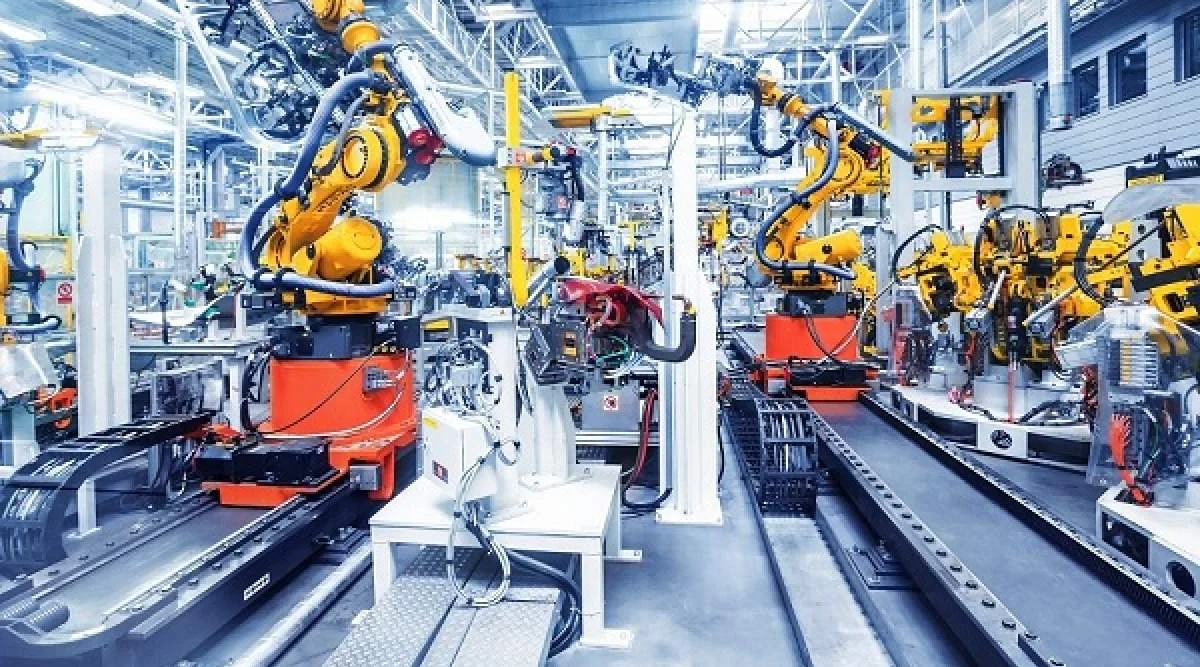
A typical IIoT ecosystem connects sensors, industrial controllers, communication networks, cloud platforms, and analytics software to create a fully connected manufacturing environment.
Core Components of an Industrial IoT System
A successful IIoT deployment combines multiple technologies that work together to collect, transmit, analyze, and act upon industrial data.
Although implementations vary across industries, most IIoT systems include the following core components.
Smart Sensors
Sensors are the foundation of every IIoT solution.
Unlike traditional sensors that simply generate electrical signals, smart sensors often include embedded processors capable of filtering data, performing diagnostics, and communicating directly with industrial networks.
Common IIoT sensors measure:
Temperature
Pressure
Flow
Humidity
Vibration
Acoustic emissions
Position
Speed
Voltage
Current
Tank level
Chemical composition
These sensors continuously collect operational information and transmit it to controllers or edge devices for processing.
Modern wireless sensors also simplify installation by reducing wiring costs while enabling monitoring of previously inaccessible equipment.
Recommended Related Articles
- Industrial Automation Fundamentals
- Industrial Communication Protocols
- Industrial Instrumentation Control
- Industrial Networking & IIoT
- Industrial Sensors & Measurement
- Motion and Process Control
- PLC Programming & Controllers
- SCADA and DCS Systems
- Servo Motors and Motor Drives
Leave a Reply